
Waterfall loss chart
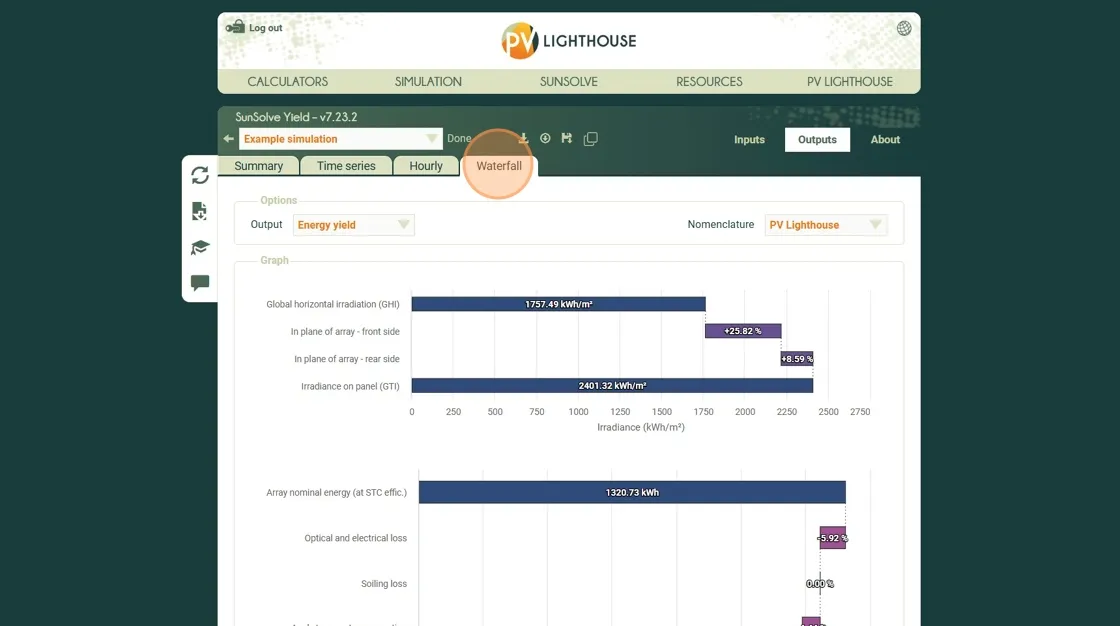
SunSolve provides a progressive breakdown of the optical, thermal, and electrical losses within the system using a waterfall-style chart. Each bar in the chart represents a stage in the energy flow — from incident sunlight, through the DC output of the modules, to the AC output of an inverter. This helps identify which processes contribute most to performance losses, such as optical shading, temperature effects, or electrical mismatch. It also provides a useful visual tool for a quick sanity check of the simulation results.
The upper section of the chart displays the irradiation components, showing how the in-plane irradiation on the front and rear sides compares with the global irradiation on a horizontal plane. The lower section presents the energy yield chain, beginning with the array’s nominal energy and applying successive gains and losses until the final AC energy output is reached.
Whilst some losses can be individually quantified by SunSolve within a single simulation, many cannot. It is the nature of a solver based on physical models that some effects cannot easily be separated out. Many of those combined losses are included in the category Optical and electrical loss. See the descriptions below for more details.
Note on timestep accumulation: All values in this waterfall are accumulated over the simulation period. Values are calculated by multiplying individual time step results by timestep duration (hours) and then summing over all timesteps in the simulation (indexed by ).
Irradiation waterfall
Section titled “Irradiation waterfall”The top section of the waterfall chart shows the irradiation incident on the solar array, accounting for array geometry, orientation, and row-to-row shading. This section displays irradiation values in kWh/m².
Global irradiation on a horizontal plane
Section titled “Global irradiation on a horizontal plane”Units: kWh/m²
Description: Total solar irradiation received on a horizontal surface, including both direct beam and diffuse components. This represents the baseline solar resource available at the site.
Calculation: Summed from weather file data over the analysis period.
Front plane-of-array irradiation
Section titled “Front plane-of-array irradiation”Units: kWh/m², %
Description: Total irradiation incident on the front surface of the module array, accounting for the array tilt and orientation, summed over the simulation time range. The difference between this and represents the gain or loss due to the array mounting angle.
Calculation: Calculated using a view factor model that transposes irradiance to the tilted plane, including direct beam, diffuse sky, and ground-reflected components. The view factor model inherently accounts for row-to-row shading and is the same model described for the thermal model. Note that optical losses such as IAM, structure shading (torque tubes, mounting rails), and spectral effects are not included at this stage—they appear later in the waterfall under Optical and electrical loss.
Loss/Gain fraction: Change relative to global irradiation on a horizontal plane, expressed as a percentage.
Rear plane-of-array irradiation
Section titled “Rear plane-of-array irradiation”Units: kWh/m², %
Description: The irradiation incident on the rear surface of the module, summed over the simulation time range. This entry only appears for bifacial systems (i.e. simulations in which the module used is designated as being bifacial).
Calculation: Calculated using the same view factor model as described for the thermal model, which includes ground-reflected, sky direct and sky diffuse components reaching the rear surface. The model inherently accounts for row-to-row shading effects on the rear surface. Optical losses such as IAM, structure shading and spectral effects are not included—they appear later in the waterfall under Optical and electrical loss.
Gain fraction: Additional irradiation relative to front-side in-plane irradiation.
Global tilted irradiation
Section titled “Global tilted irradiation”Units: kWh/m²
Description: Total global irradiation on the surfaces of the tilted module. For monofacial modules, this equals the front-side irradiation. For bifacial modules, this is the sum of front and rear irradiation.
Calculation: Simple sum of the front and rear irradiation from above. Rear side is only included for bifacial modules.
For monofacial modules:
For bifacial modules:
Note: The bifaciality factor (fb) of the module does not affect this irradiation calculation. The bifaciality factor describes how the light absorbed on the rear-side is converted to electrical power in the solar cells. The value is a raw optical value before electrical conversion.
Electrical energy waterfall
Section titled “Electrical energy waterfall”The lower section of the waterfall chart shows the conversion of incident irradiation into electrical energy, with successive losses applied through the energy conversion chain.
Array nominal energy
Section titled “Array nominal energy”Units: kWh, kWh/kWp, or kWh/m²
Description: Theoretical DC energy that would be produced if the modules operated at their rated efficiency for all incident irradiation. This represents the starting point for the electrical energy waterfall.
Calculation: This nominal energy is calculated by multiplying the global tilted irradiation by the module efficiency and total module area:
Where:
- is the theoretical energy at STC efficiency (kWh)
- is the global tilted irradiation (kWh/m²)
- is the module efficiency at standard test conditions
- is the total module area (m²)
Optical and electrical loss
Section titled “Optical and electrical loss”Units: kWh, kWh/kWp, or kWh/m², %
Description: Combined losses due to optical effects and electrical performance variations. This category includes multiple effects that cannot easily be separated in the physics-based solver including:
- Optical losses within the module structure (reflection and absorption in glass and encapsulant)
- Incidence angle modifier (IAM) at the module surfaces
- Spectral effects from wavelength-dependent behavior of incident light and scene materials
- Wavelength-dependent ground albedo and its effect on irradiation
- External quantum efficiency of the solar cells and module
- Shading from system structure (e.g., tracker torque tube, mounting rails)
- Multiple reflections between surfaces in the scene (module glass, ground, adjacent rows)
- Low irradiance electrical performance effects
- Cell absorption variations across the module
Two major contributors to this category are:
- The difference between theoretical irradiation values shown in the irradiation waterfall (calculated using the view factor model) and the actual light absorbed by the solar cells (determined through wavelength-dependent ray-tracing)
- The use of equivalent-circuit solving to calculate each cell’s power output, which captures non-ideal electrical behavior that the nominal STC efficiency does not account for.
Calculation:
- Ray tracing is used to determine the optical absorption within each cell (typically the wafer bulk and a set of collecting layers). This absorption is wavelength dependent, recorded separately for direct and diffuse light, and is recorded separately in the main absorber for front and rear entrance of the light.
- The absorption is combined with the collection efficiency and incident spectra to determine the photocurrent density for each sub-circuit within each cell.
- The IV curve of every sub-circuit is solved at 25 °C. Note that standard cell architectures have a single sub-circuit. Tandem devices have two or more. These are sub-circuits within each individual solar cell.
- From these curves the power at the maximum power point is extracted for each sub-circuit ().
- The energy is then calculated by summing the output power of every solar cell in the unit-system. For solar cells that contain multiple circuits (i.e. tandems) the energy is the sum of the maximum power output of each sub-circuit (i.e. there is no mismatch loss at this stage between sub-circuits)
The power of each cell is determined as:
where:
- is the maximum power of cell at timestep , calculated at the nominal temperature of 25 °C (W)
- is the maximum power of the -th sub-circuit within cell at timestep , calculated at 25 °C (W)
- is the number of sub-circuits per cell (e.g., 1 for single-junction cells, 2 or more for tandem cells)
- is the cell index
- is the sub-circuit index within a cell
- is the timestep index
For Module DC simulations, the energy is calculated by summing over all cells in the ray-traced unit-system:
where:
- is the DC energy after optical and electrical losses (kWh)
- is the total number of cells in the ray-traced unit-system
- is the cell index
- is the maximum power point output of cell at timestep , calculated at 25 °C (W)
For String DC and Array AC simulations, the unit-system result is scaled to the full electrical system:
Where:
- is the actual DC energy after the lumped optical and electrical losses (kWh)
- is the maximum power point output of cell at timestep , calculated at the nominal temperature of 25 °C (W)
- is the total number of modules in the electrical system
- is the number of modules in the ray-traced unit-system
The optical and electrical loss is then:
Loss fraction: Relative to nominal energy at STC efficiency
Calculation notes:
- The module bifaciality factor () is not applied at this stage. Rear-side electrical conversion is determined directly from the cell equivalent-circuit model, not scaled by an external bifaciality parameter.
- Although it is not made explicit in the equations, the implementation of it in SunSolve accounts for the fact that a string or array definition may result in some cells appearing more often than others.
Soiling loss
Section titled “Soiling loss”Units: kWh, kWh/kWp, or kWh/m², %
Description: Energy loss due to dirt, dust, or other contaminants on the module surface that reduce light transmission into the solar cells.
Calculation: The soiling loss reduces the photocurrent density of each cell:
Where is the photocurrent density determined from ray-tracing (before soiling), and is the user-defined soiling fraction (0 to 1). This can vary by timestep if time-varying soiling data is provided.
The energy with soiling is then recalculated by solving each cell independently at 25 °C:
For Module DC simulations:
For String DC and Array AC simulations:
The soiling loss is:
Where:
- is the photocurrent density from ray-tracing before soiling (mA/cm²)
- is the reduced photocurrent density after soiling (mA/cm²)
- is the soiling loss fraction (dimensionless)
- is the power output of cell with soiling reduced photocurrent
- is the DC energy after soiling loss (kWh)
- is the DC energy before soiling loss (kWh)
Loss fraction:
Note: If the solar cell has more than one sub-circuit (i.e. it is a tandem cell), then the of both sub-circuits is reduced. The cell power is determined as the sum of the sub-circuits (i.e. without interconnection) as described earlier.
Apply temperature correction
Section titled “Apply temperature correction”Units: kWh, kWh/kWp, or kWh/m², %
Description: Energy change due to the difference between actual cell operating temperature () and the STC reference temperature (25 °C). This is typically a loss in most conditions but can be a small gain in cold climates.
Calculation: The equivalent-circuit parameters of each cell, including the photocurrent, are adjusted for the calculated module operating temperature:
The energy is then recalculated with temperature-corrected parameters:
For Module DC simulations:
For String DC and Array AC simulations:
The temperature correction (loss or gain) is:
Where:
- is the temperature-corrected photocurrent (mA/cm²)
- is the calculated cell operating temperature (°C)
- is the power output of cell with temperature-adjusted equivalent-circuit parameters
- is the DC energy after temperature correction (kWh)
- is the DC energy at 25 °C with soiling (kWh)
Loss fraction:
Note: If the solar cell has more than one sub-circuit (i.e. it is a tandem cell), then the of both sub-circuits is adjusted for . The cell power is determined as the sum of the sub-circuits (i.e. without interconnection) as described earlier.
Cell-to-cell mismatch loss
Section titled “Cell-to-cell mismatch loss”Units: kWh, kWh/kWp, or kWh/m², %
Description: Energy loss due to electrical mismatch between cells within a module. Cells experience different irradiances due to non-uniform illumination (e.g., partial shading, edge effects), causing them to operate at different current levels. Series-connected cells must carry the same current, forcing some cells away from their maximum power point, thus resulting in power loss. For cells with multiple sub-circuits (i.e. tandems) this step also accounts for the mismatch between those sub-circuits.
Calculation: Cells within each module are now electrically connected in their series/parallel configuration. The difference between the sum of individual cell maximum powers and the actual module maximum power represents the mismatch loss. Impact of bypass diodes is included.
For Module DC simulations:
For String DC and Array AC simulations:
The cell-to-cell mismatch loss is:
Where:
- is the maximum module power with cells electrically connected (W)
- is the DC energy with cell-to-cell mismatch (kWh)
- is the sum of independent cell powers at operating temperature (kWh)
Loss fraction:
DC energy (from modules)
Section titled “DC energy (from modules)”Units: kWh, kWh/kWp, or kWh/m²
Description: Total DC electrical energy output from all modules, including all losses up to this point (optical, electrical, soiling, temperature, and cell-to-cell mismatch). For module-only simulations, this is the final output.
Calculation: This equals calculated in the cell-to-cell mismatch step:
Where:
- is the output DC energy from all modules (kWh)
- is the DC energy after cell-to-cell mismatch losses (kWh)
Note: This is an intermediate total in the waterfall, representing the energy before string/array level effects.
Module-to-module mismatch loss
Section titled “Module-to-module mismatch loss”Units: kWh, kWh/kWp, or kWh/m², %
Description: Energy loss due to electrical mismatch between modules connected in series within a string. Different modules experience different operating conditions (irradiance, temperature, soiling), but must carry the same current when connected in series.
For Array AC simulations: This loss category also includes string-to-string mismatch. When multiple strings are combined in parallel, they must operate at the same voltage, preventing each string from operating at its individual maximum power point. The total reported loss accounts for both series combination (modules → strings) and parallel combination (strings → array).
Calculation: Module-to-module mismatch is calculated by combining module IV curves in series (for strings) or both series and parallel (for arrays). See the String IV curve and Array IV curve sections in System electronics for algorithm details.
For String DC:
For Array AC:
and the corresponding loss is:
Where:
- is the DC energy from modules, which is the sum of independent module powers (kWh)
- is the DC energy at string MPP (for String DC simulations) or at array MPP (for Array AC simulations), before application of DC wiring loss (kWh)
- represents all defined string configurations in the system
- is the string maximum power point at timestep (W)
- is the array maximum power point at timestep (W)
Loss fraction:
Note: This entry only appears for string and array simulations (not module-only simulations).
Ohmic wiring loss MPP
Section titled “Ohmic wiring loss MPP”Units: kWh, kWh/kWp, or kWh/m², %
Description: DC energy loss due to resistive (I²R) losses in the wiring between modules, strings and inverters, calculated at the maximum power point of the array.
Calculation: At each timestep, the instantaneous wiring power loss is calculated at the array’s maximum power point, then converted to energy by multiplying by the timestep duration. See DC operating point and wiring losses for the detailed calculation.
Where:
- is the total wiring energy loss at MPP over the simulation period (kWh)
- is the instantaneous wiring power loss at timestep (W)
- is the array current at maximum power point at timestep (A)
- is the DC wiring resistance between array and inverter (Ω)
Loss fraction:
Note: This is the wiring loss at the array maximum power point. An additional “correction” is applied later to account for the actual inverter operating point.
Array virtual energy at MPP
Section titled “Array virtual energy at MPP”Units: kWh, kWh/kWp, or kWh/m²
Description: The DC energy that would be available at the array maximum power point, after accounting for module-to-module mismatch and wiring losses, but before inverter constraints are applied.
Calculation: This is the remaining energy after subtracting mismatch and wiring losses from the module output:
Where:
- is the virtual DC energy at array MPP (kWh)
- is the DC energy from modules (kWh)
- is the module-to-module mismatch loss (kWh)
- is the ohmic wiring loss at MPP (kWh)
Note: This is a “virtual” energy because the inverter may not operate the array at its true MPP due to voltage, current, or power constraints.
Correction to wiring loss at operating point
Section titled “Correction to wiring loss at operating point”Units: kWh, kWh/kWp, or kWh/m², %
Description: Adjustment to the wiring loss to account for the difference between the array operating at MPP versus the inverter-imposed operating point. When the inverter forces the array away from MPP (due to Vmin, Vmax, or Imax constraints), the current changes, affecting I²R losses.
Calculation: Difference between wiring loss at the actual operating point and wiring loss at MPP. See AC output and power limiting step 4 for the algorithm details.
Where:
- is the total wiring loss correction over the simulation period (kWh)
- is the instantaneous wiring power loss at the actual operating point at timestep (W)
- is the instantaneous wiring power loss at MPP at timestep (W)
- is the array current at the inverter-imposed operating point at timestep (A)
- is the array current at maximum power point at timestep (A)
- is the DC wiring resistance (Ω)
Loss fraction:
Note: This can be positive (indicating additional loss when operating point current exceeds MPP current) or negative (indicating reduced loss when operating point current is below MPP current).
Clipping loss
Section titled “Clipping loss”Units: kWh, kWh/kWp, or kWh/m², %
Description: Energy loss that occurs when the DC power at the inverter input (when the array operates at its maximum power point) would produce AC output exceeding the inverter’s rated AC power limit. To prevent this, the inverter adjusts the array’s operating point by increasing voltage, which moves the array along its IV curve to a lower power point. This reduces the DC input power and current to the inverter. The clipping loss is the difference between the DC power available at MPP and the reduced DC power after this adjustment. It is measured as a DC power loss at the inverter input (after accounting for DC wiring losses).
Calculation: At each timestep:
- Calculate the DC power at the inverter input when the array operates at MPP:
- If the resulting AC power would exceed the inverter’s AC limit, adjust the array operating point by increasing voltage
- Calculate the reduced DC input power after adjustment:
- The clipping loss is:
Where:
- is the total clipping loss (kWh)
- is the DC power at the inverter input at array MPP at timestep (W)
- is the DC power at the inverter input after adjusting for AC power limit at timestep (W)
Both and are measured at the inverter DC input terminals and account for DC wiring losses at their respective operating points. See AC output and power limiting for the detailed algorithm.
Loss fraction:
Inverter loss due to power threshold
Section titled “Inverter loss due to power threshold”Units: kWh, kWh/kWp, or kWh/m², %
Description: Energy loss when array DC power falls below the inverter’s minimum operating threshold ( or ). Below this power level, the inverter cannot operate and no energy is converted.
Calculation: At timesteps where array power is below the threshold, all available DC energy is lost:
Where:
- is the total power threshold loss (kWh)
- is the DC power available after clipping at timestep (W)
- is the inverter’s minimum operating power threshold (W)
See Inverter input constraints for how this constraint is applied in the algorithm.
Loss fraction:
Inverter loss due to voltage threshold
Section titled “Inverter loss due to voltage threshold”Units: kWh, kWh/kWp, or kWh/m², %
Description: Combined losses when the array maximum power point voltage falls outside the inverter’s operating voltage window (below or above ). The inverter forces the array to operate at the voltage limit rather than at MPP.
Calculation: When the array MPP voltage falls outside the inverter’s operating window, the loss is:
Where:
- is the total voltage threshold loss (kWh)
- is the array power at its maximum power point (W)
- is the power when constrained to voltage limits:
- If :
- If :
- Otherwise:
- and are the inverter’s minimum and maximum input voltages (V)
Breakdown:
- Vmin loss: When MPP voltage < Vmin, array is operated at Vmin
- Vmax loss: When MPP voltage > Vmax, array is operated at Vmax
See Inverter input constraints for the detailed algorithm.
Loss fraction:
Inverter loss due to max input current
Section titled “Inverter loss due to max input current”Units: kWh, kWh/kWp, or kWh/m², %
Description: Energy loss when the array current at MPP exceeds the inverter’s maximum input current rating (Imax). The inverter limits the array current, forcing operation away from the true MPP.
Calculation: When array current at MPP exceeds the inverter’s maximum input current:
Where:
- is the total current limit loss (kWh)
- is the array power at maximum power point (W)
- is the array power when current is limited to (W)
- is the inverter’s maximum input current rating (A)
See Inverter input constraints for the detailed algorithm.
Loss fraction:
DC energy at inverter input
Section titled “DC energy at inverter input”Units: kWh, kWh/kWp, or kWh/m²
Description: Total DC energy available at the inverter input terminals after all DC losses and inverter operating point constraints have been applied. This is the energy that will be converted to AC.
Calculation: The inverter constraints (clipping, , , , ) force the array to operate away from its maximum power point. When this happens, both the array power and the DC wiring losses change. The energy at the inverter input is:
Where:
- is the DC energy at inverter input (kWh)
- is the virtual DC energy at array MPP after wiring loss at MPP (kWh)
- , , , are the inverter constraint losses (kWh)
- is the correction to wiring loss (kWh, can be negative)
Note: This represents the actual DC energy the inverter will process. The constraint losses are calculated based on the reduction in DC power at the inverter input when moving from the MPP operating point to the constrained operating point.
Inverter loss during operation (efficiency)
Section titled “Inverter loss during operation (efficiency)”Units: kWh, kWh/kWp, or kWh/m², %
Description: Energy loss due to the inverter’s conversion efficiency. Inverters cannot convert DC to AC with 100% efficiency due to switching losses, transformer losses, and other internal power consumption during operation.
Calculation: Energy loss due to inverter conversion efficiency:
Equivalently:
Where:
- is the total conversion loss (kWh)
- is the DC input power at timestep (W)
- is the inverter efficiency as a function of power and voltage (dimensionless)
- is the DC input voltage at timestep (V)
- is the gross AC energy before night consumption (kWh)
See Inverter conversion efficiency for details on the efficiency model.
Loss fraction: Relative to DC energy at inverter input.
Night consumption
Section titled “Night consumption”Units: kWh, kWh/kWp, or kWh/m², %
Description: AC energy consumed by the inverter during nighttime or non-generating periods for internal operations such as cooling fans, displays, communication systems, and standby power.
Calculation: AC energy consumed during non-generating periods:
Where:
- is the total nighttime consumption (kWh)
- is the set of timesteps when the inverter is not generating power
- is the inverter’s nighttime consumption power (W)
Loss fraction: Relative to AC energy after conversion.
AC energy at inverter output
Section titled “AC energy at inverter output”Units: kWh, kWh/kWp, or kWh/m²
Description: Final net AC electrical energy output from the system, representing the energy delivered to the grid or load. This is the bottom line of the waterfall chart and includes all optical, thermal, electrical, and inverter losses.
Calculation: Final AC energy after all losses:
Equivalently, summing from nominal energy:
Where:
- is the net AC energy output (kWh)
- is the gross AC energy after inverter conversion (kWh)
- All terms are losses where positive values represent energy lost
- is typically positive (loss) but can be negative (gain) in cold climates
- can be positive (wiring loss increased at constrained operating point) or negative (wiring loss decreased) relative to MPP
Note: This is the final output value used for energy yield calculations and performance metrics.
Important calculations
Section titled “Important calculations”Module STC efficiency
Section titled “Module STC efficiency”The module efficiency used in the waterfall calculations is derived from the module’s rated specifications (i.e. the nominal module power).
Calculation:
Where:
- is the module efficiency at standard test conditions (dimensionless fraction)
- is the area of a single module (m²)
Total module area
Section titled “Total module area”The total module area calculation varies depending on the simulation type, accounting for the difference between the ray-traced optical unit-system and the electrical array definition.
For Module DC simulations: The total module area equals the sum of all module areas in the ray-traced unit-system.
For String DC and Array AC simulations: The total module area is scaled based on the electrical array definition:
Where:
- is the area of a single module (m²)
- is the total number of modules in the electrical array (accounting for string length and parallel strings)
Example scenario:
- Ray-traced unit-system: 7 modules
- Each module: 2.0 m²
- String configuration: 28 modules per string
- For String DC solve: m²
For Array AC simulations: The calculation extends further to include multiple strings in parallel:
This approach allows SunSolve to ray-trace a representative unit-system while accurately calculating energy yields for much larger field layouts by scaling the per-module results to the full electrical array definition.
Note: The unit-system area from ray-tracing represents the optical simulation domain, while the total module area represents the actual installed module area used in energy calculations.
Losses that can be isolated via comparative analysis
Section titled “Losses that can be isolated via comparative analysis”Some loss components cannot be individually quantified in a single simulation because they are inherently coupled in the physics-based solving process. However, these can be estimated by running multiple simulations with specific features enabled or disabled:
- Spectral loss/gain: Compare simulations with spectral solving enabled versus disabled
- Shading loss: Compare a baseline simulation to one in which all structure is set to be transparent.
- Bifacial gain: Compare a baseline simulation to one in which the module rear surface is covered by a black absorber.
- Albedo effects: Compare simulations with different ground albedo values
Other losses may be calculated by creating an alternative module. For example, for IAM losses create a module with the IAM set to 100% at all angles.