
Simple vs complex modules
In SunSolve Yield, a module can be one of two types:
- Simple, or
- Complex.
Simple modules are typically used by system engineers when conducting yield forecasts, capacity tests and simulation experiments.
Complex modules are typically used by manufacturers when assessing the performance of their modules under real-world conditions. Complex modules provide a more sophisticated way to simulate the module optics, but they take longer to solve and require a very detailed knowledge of the module’s components.
See our Module types overview video for a visual description of the module types, and of loading them into SunSolve.
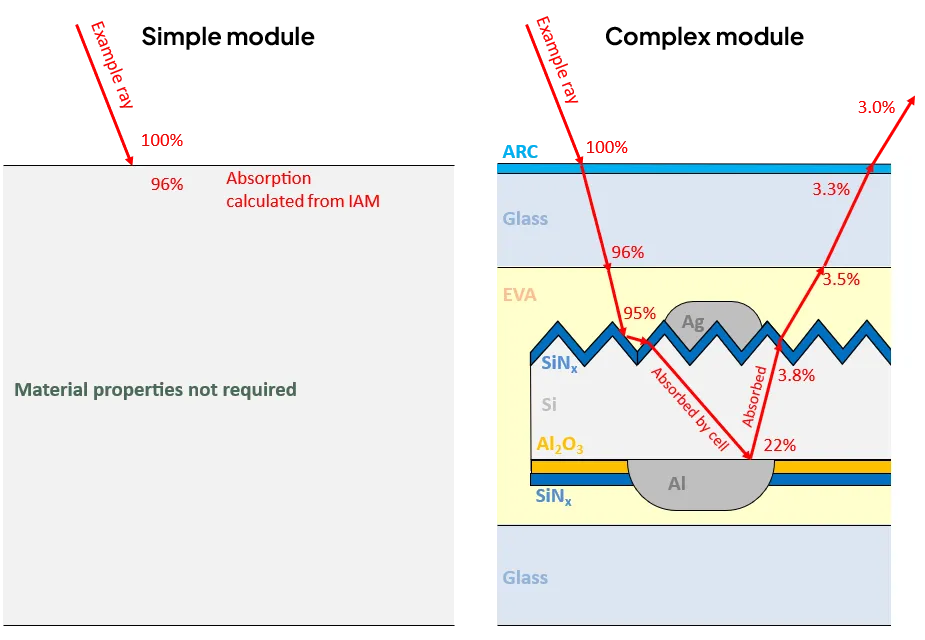
Figure: Partial cross-section of a simple and a complex module. The red values display the intensity of an example ray as it propagates within the module. Simple modules do not, and complex modules do, account for the materials and dimensions of their internal components.
Simple modules
Section link: Simple modulesA simple module treats the active area as a uniform block of equal-sized cells. Light is ray traced until it intersects the surface of the module, where a lookup table determines the fraction that is reflected, parasitically absorbed, and usefully absorbed.
Because the interior of the module is not ray traced, a simple module neglects the spatial variation within the module, such as the gaps between cells and around the module perimeter. It cannot compute the small non-uniformity in cell current caused by light being scattered by the backsheet and internally reflected onto adjacent cells.
The optics are described in simple module optics.
Complex modules
Section link: Complex modulesA complex module defines the complete physical structure of the module. It includes the thickness and refractive index of the glass, the EVA, and the antireflection coatings; the shape and dimensions of the cells and their layout within the module; the dimensions, cross-section and refractive index of the electrodes (fingers, busbars, ribbons); the texture of the interfaces; and interface scattering, like from a backsheet.
As such, SunSolve Yield can ray trace the light into the module and into the solar cells therein.
Unlike for a simple module, the wavelength- and angular-dependent behaviour of a complex module does not need to be specified. SunSolve calculates the behaviour from the material properties using physical equations (Fresnel, thin-film and scattering equations).
A complex module is typically constructed and simulated in SunSolve Power before being loaded into SunSolve Yield.
The optics are described in complex module optics.
Choosing a module type
Section link: Choosing a module typeChoose a simple module when
- you have a module’s PAN file or datasheet, but not its detailed physical structure;
- you want a fast simulation and a small simulation budget; or
- the results of your simulation experiment will be negligibly influenced by the module optics, e.g., when computing the relative impact of changing the module height.
Choose a complex module when
- you are studying the cell or module design itself, such as the cell spacing, the electrodes, the textures or the coatings;
- the module is semitransparent (like the modules used in agriPV) so that light passes between and through the cells; or
- you want to apply the best possible representation of the optical system.
If you are unsure which module type to choose, please contact us at support@sunsolve.com.
Differences between simple and complex modules
Section link: Differences between simple and complex modulesThe table and the text below summarise the major differences between simple and complex modules. Both types have the same electrical layout and can include a frame.
Surface optics, IAM(θ),, R(λ) or Fresnel and thin-film optics, Fresnel and thin-film optics; accounts for texture
Cell layout, No cell spacing, Cell spacing,, cell groups and module perimeter.